Skip to product information
Sold out

Chelated + Soluble Liquid Iron Concentrate

Coming Soon
This product is currently in final testing and may be available soon. Check back for launch updates.

When new leaves come in yellow while the veins stay green, that is iron chlorosis, and it is one of the most common problems on citrus, blueberries, gardenias, and other acid-loving plants. GrowScripts Liquid Iron is built to fix it. It combines chelated and soluble iron from three sources, so the plant can take iron up quickly through the leaves and hold onto it over time, greening up pale foliage and supporting strong new growth. Mix it with water and spray it on, and because foliar feeding works no matter your soil, it reaches the plant even where the soil locks iron away.

Key features

Corrects iron chlorosis: greens up the yellow-leaves-with-green-veins pattern of iron deficiency.
Chelated plus soluble iron: three iron sources for both quick uptake and lasting availability.
Foliar-first: works regardless of soil pH, so it reaches the plant even in alkaline soil that locks iron away.
Gentle and easy: a liquid concentrate you mix and spray, formulated to green leaves without burning.
Great for acid-loving plants: citrus, blueberries, gardenias, azaleas, hydrangeas, figs, and container plants.

Ingredients

  • 3% iron (Fe) from three sources: chelated iron (EDTA), ferrous sulfate, and iron gluconate, for both immediate and lasting availability.
  • Sulfur (0.40%), which supports uptake.
  • Citric acid and sodium gluconate, which keep the formula stable and the iron available.

How to use

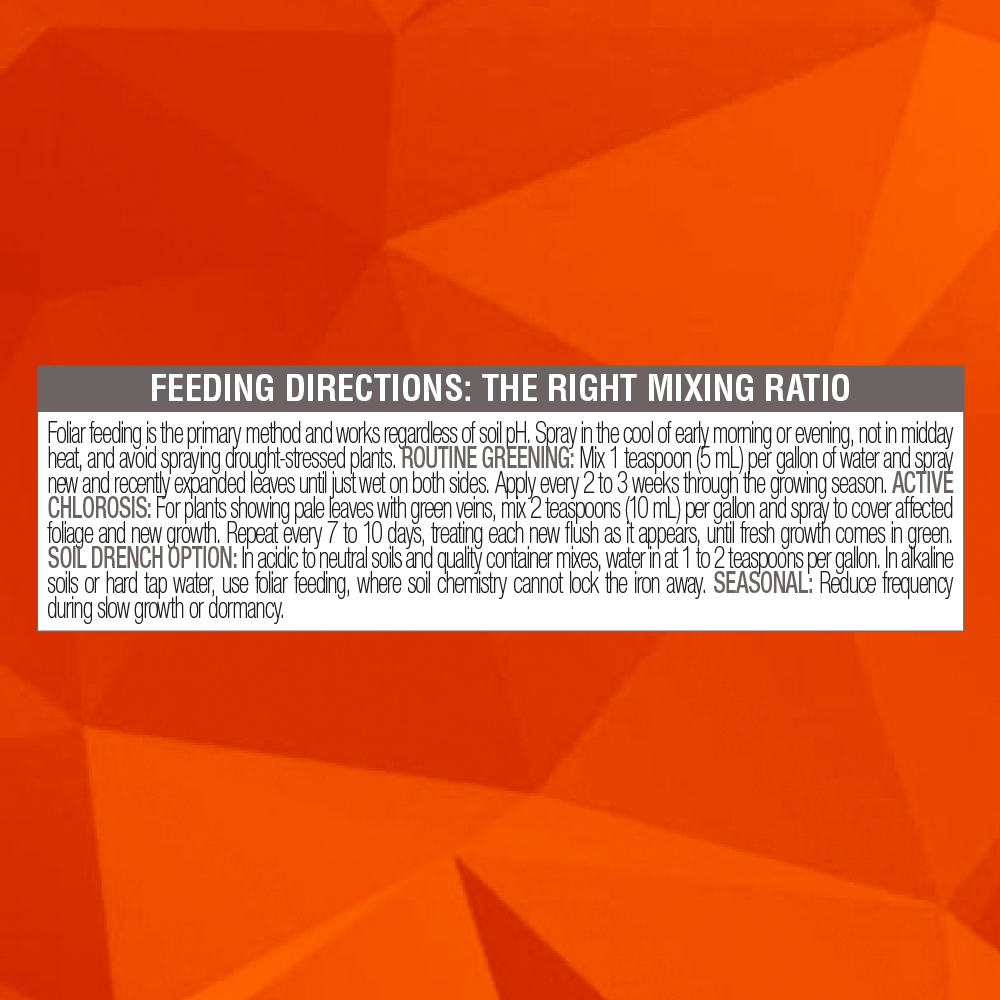
Foliar spraying is the primary method, since it works regardless of soil pH. Spray in the cool of early morning or evening, not midday, and avoid drought-stressed plants.

  • Routine greening: mix 1 teaspoon (5 mL) per gallon of water and spray new and recently expanded leaves on both sides, every 2 to 3 weeks through the growing season.
  • Active chlorosis: for leaves already showing pale color with green veins, mix 2 teaspoons (10 mL) per gallon, cover the affected foliage and new growth, and repeat every 7 to 10 days, treating each new flush until fresh growth comes in green.
  • Soil drench option: in acidic to neutral soils and quality container mixes, water in 1 to 2 teaspoons per gallon. In alkaline soils or with hard tap water, use foliar feeding instead, since soil chemistry there locks the iron away before roots can take it up.
  • Seasonal: reduce frequency during slow growth or dormancy.

Why?

Iron is what plants use to make chlorophyll, the pigment that makes leaves green, so when iron runs short new growth turns pale and yellow while the veins stay green. This usually happens not because the soil lacks iron, but because high pH or nutrient lockout makes the iron unavailable to the roots. Liquid Iron solves that two ways: chelated and soluble iron the leaf can absorb directly through foliar feeding, which sidesteps soil pH entirely, plus soil-applied iron where the soil is acidic enough to keep it available. The result is green new growth and vigorous color through the season.

Makes how much?

One 8 fl oz bottle makes multiple gallons of finished spray when mixed to the label rate, enough for many applications and many treatments across a season.

View full details

Frequently Asked Questions

What plants can I use Liquid Iron on?


GrowScripts Liquid Iron works well on citrus, blueberries, figs, gardenias, hydrangeas, azaleas, vegetables, ornamentals, and many other plants that benefit from supplemental iron, especially acid-loving plants prone to iron chlorosis.

How do I know if my plant needs iron?

Iron deficiency shows as yellow leaves with green veins, especially on new growth, a pattern called interveinal chlorosis. Pale foliage and slow growth on the newest leaves are the tell. It is most common on acid-loving plants and on plants in alkaline or high-pH soil.

What is the difference between chelated and soluble iron?

Chelated iron stays available to plants over a wider range of soil conditions, while water-soluble iron provides quick availability. This formula combines both, plus a third iron source, so you get immediate greening and longer-lasting iron nutrition.

Can I apply Liquid Iron as a foliar spray?

Yes, and foliar spraying is the primary method, because it delivers iron straight to the leaves regardless of soil pH. You can also apply it as a soil drench in acidic to neutral soils, though in alkaline soil foliar feeding is the reliable choice.

Will this fix yellow leaves?

If the yellowing is from iron deficiency, Liquid Iron can restore healthy green growth. Leaves already badly yellowed may not fully re-green, but new growth should come in green with continued treatment. If yellowing is uniform across the whole leaf including the veins, the cause is more likely nitrogen or overwatering than iron.

How often should I apply Liquid Iron?

For maintenance, every 2 to 3 weeks during active growth. For a plant actively showing chlorosis, every 7 to 10 days until new growth greens up. Container plants and those in alkaline soils tend to need periodic applications through the season.

All about iron chlorosis and how to fix it

What iron chlorosis looks like

Iron chlorosis has a signature that is easy to recognize once you know it: the newest leaves turn pale yellow or almost white while the veins stay distinctly green, a pattern called interveinal chlorosis. It shows on new growth first because iron does not move around the plant easily, so the freshest leaves feel the shortage soonest. Uniform yellowing that includes the veins, or yellowing of older leaves, usually points to something else, like nitrogen or overwatering, so the green-veins detail is the thing to look for.

Why plants run short on iron even when soil has plenty

The surprising part of iron chlorosis is that it is rarely a lack of iron in the soil. More often the iron is there but locked up and unavailable, because the soil pH is too high, the soil is waterlogged, or nutrient competition ties the iron up. That is why acid-loving plants, blueberries, gardenias, azaleas, and citrus, are the usual sufferers: they need acidic conditions to take up iron, and in neutral or alkaline soil they cannot reach it no matter how much is present.

Why foliar feeding is the reliable fix

Because the problem is usually availability rather than quantity, adding more iron to alkaline soil often does not help, since it locks up the same way. Spraying iron directly onto the leaves sidesteps the soil entirely, letting the plant absorb it where it is needed, which is why foliar feeding is the primary method for this product and the dependable choice in high-pH soil. In genuinely acidic soil, a soil drench works too, and pairing iron correction with keeping the soil acidic, especially for blueberries, is the lasting solution.

Iron and your acid-loving plants

If you grow blueberries, gardenias, azaleas, or container citrus, iron chlorosis is a problem you will likely meet, and it is worth keeping this on hand. For blueberries in particular, iron correction goes hand in hand with acidic soil, since the two problems share a root cause. Treating chlorosis early, at the first pale new leaves, keeps the plant productive and green rather than letting it decline through a season.

Related products