

Skip to product information
Sale

Fig Tree Fertilizer Kit for Large & In-Ground Trees

$44.99
$40.99
 per 
Shipping calculated at checkout.

You planted a fig for the fruit, for baskets of sweet, ripe figs off your own tree, not for yellowing leaves, dropped fruit, or figs that split open before you can pick them.

But once a fig moves into a large container or goes into the ground, it grows fast and feeds hard, and the small kit that fed it before runs out long before the season does. Underfeed a vigorous fig and it shows plainly: weak branches, pale leaves, small fruit, and fruit that cracks as it ripens.

What fig growers want is simple. Feed the tree enough, at the right time, and keep the fruit firm and whole.

That is what this kit does. It carries enough season-long feeding, micronutrient support, and calcium for firmer fruit for a large container fig or a young to mid-size in-ground tree, whether it is Brown Turkey, Celeste, LSU Purple, Chicago Hardy, or another variety, applied as one simple routine instead of four.

Key features

Sized for large containers and young to smaller in-ground figs. One kit feeds a 30-gallon container tree, two 15-gallon trees, or three 10-gallon trees for a full season.
Controlled-release NPK 18-6-12, 6 to 8 month release. A nitrogen-forward feed for steady canopy growth and fruit over months rather than days.
Micronutrient foliar or soil spray. Corrects the deficiencies that yellow fig leaves, with iron, manganese, zinc, copper, and molybdenum.
Calcium, magnesium, and boron support. Builds firmer fruit and helps reduce the splitting and cracking figs are prone to.
Pre-measured and simple. Complete fig nutrition on a simple schedule, no measuring.

Ingredients

Everything in the kit, with a season application calendar:

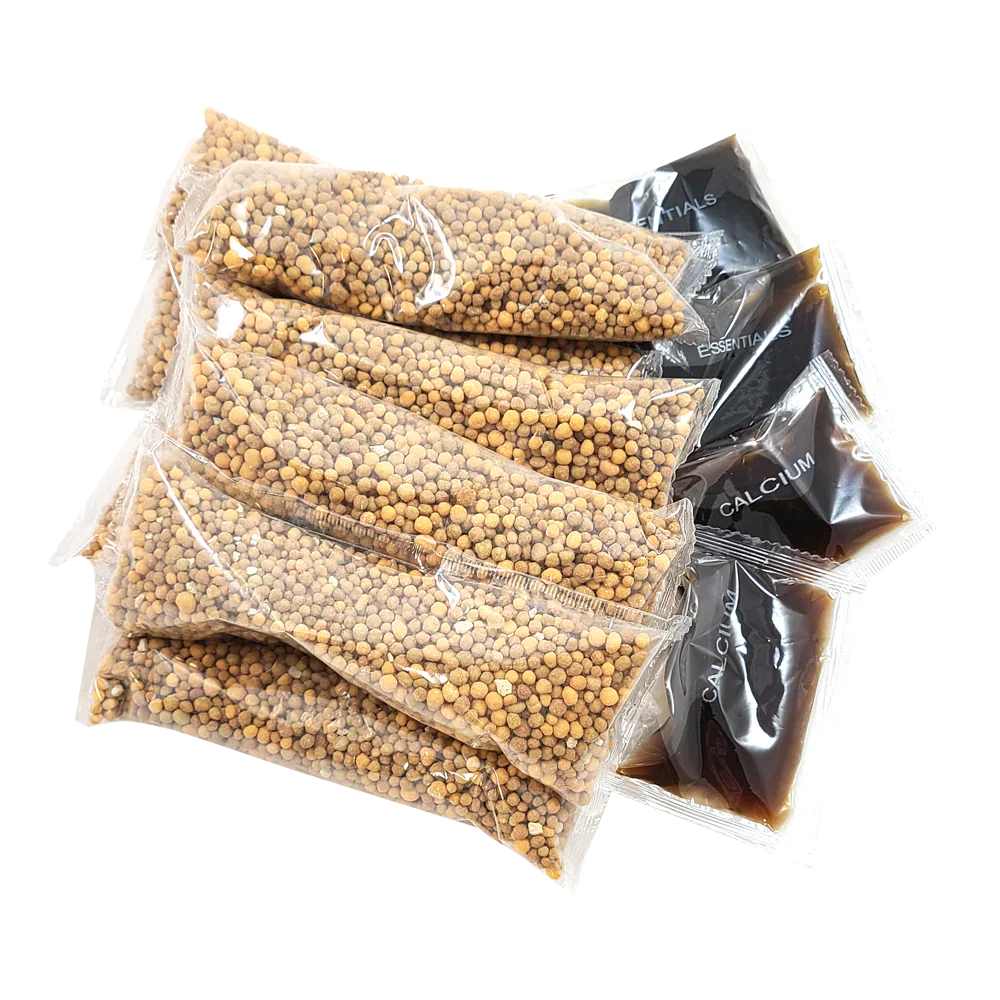
  • Controlled-release NPK 18-6-12, 6 to 8 month release. 3 cups, net wt 24.6 oz (697.4 g), covers up to 15 sq ft. Optimized for deep-root uptake and steady canopy growth.
  • Essential trace elements spray. 1 oz, net wt 1.2 oz (34 g), covers up to 312 sq ft. Iron, manganese, zinc, copper, and molybdenum for leaf color and vigor.
  • Calcium, magnesium, and boron nutrient spray. 1 oz, net wt 1.2 oz (34 g), covers up to 312 sq ft. Strengthens fruit skins and cell structure for firmer, less-split fruit.

How to use

Three products, one simple rhythm. The kit includes a container-size chart and a week-by-week calendar.

  1. NPK 18-6-12 granule, feeds the roots. Spread the pre-measured pack around the tree's dripline, the area under the outer canopy, at the amount for your tree or container size on the included chart, then water in. Reapply every two months through the growing season, for example March, May, July, and September. The coating keeps feeding between applications.
  2. Essential trace elements, for plant health. Apply as a foliar spray or as a soil drench. Foliar: mix one pack with 64 oz of water and spray the leaves every two to three weeks during active growth, more often if leaves yellow. Soil: mix one pack with 128 oz of water and drench the root zone for gentle feeding, any time to correct yellowing.
  3. Calcium, magnesium, and boron spray, for firmer fruit. Apply as a foliar spray or as a soil drench, every two to three weeks, focused on fruit set and expansion, which is when figs split. Foliar: mix one pack with 64 oz of water. Soil: mix one pack with 128 oz of water during fruit development.

Getting started: at first, apply the sprays every 5 to 7 days until the first packet is used, then settle into every two to three weeks, and reapply the granule every two months.

Why?

A fig in a large container or newly in the ground grows fast and carries a heavy fruit load, and without steady nutrition it develops weak branches, small or splitting fruit, and yellowing leaves. This kit gives a large-container or young in-ground fig complete season-long feeding plus the calcium that firms fruit, so you get vigorous growth, better fruit set, and figs that hold together to harvest.

Makes how much?

One kit feeds a single 30-gallon container tree, two 15-gallon trees, or three 10-gallon trees, and so on by total soil volume, or a young to mid-size in-ground fig, for a full growing season. Feeding one small potted fig in a 3-gallon pot or smaller? The container Fig Tree Kit is sized for that. Feeding a mature standard fig with a wide, established root zone? Plan on more than one kit to cover the full area.

View full details
Fig tree care kit packaging with a white background

Fig Tree Fertilizer Kit for Large & In-Ground Trees

$44.99
$40.99
 per 

Frequently Asked Questions

How many trees will one kit feed?

It scales by total soil volume: a single 30-gallon container tree, two 15-gallon trees, or three 10-gallon trees, and so on, or a young to mid-size in-ground fig, for a full season. Follow the per-tree rate on the label.

What size and age of tree is this for?

It is built for large container figs and young to mid-size in-ground trees. For a single small potted fig in a 3-gallon pot or smaller, the container Fig Tree Kit is the better fit. For a mature standard fig with a wide root zone, plan on more than one kit.

Can I use this on in-ground trees, or only containers?

Both. It works for large containers and raised beds and for young to mid-size in-ground figs. Application differs slightly between the two, and both methods are covered in How to use.

Which fig varieties does it work on?

Brown Turkey, Celeste, Chicago Hardy, LSU Purple, Black Mission, and other common fig varieties grown in large containers or in the ground.

Why do my figs split or crack?

Splitting usually comes from uneven watering combined with a shortage of calcium as the fruit expands. When a dry spell is followed by heavy water, the fruit swells faster than its skin can stretch and it splits. Watering consistently helps most, and the calcium spray in this kit supports firmer skins during fruit expansion, which is when cracking happens.

How is this different from the small kit?

Same feeding approach, scaled up. The small kit is sized for one fig in a 3-gallon pot or under, while this kit covers a large container tree, a few smaller potted trees, or a young to mid-size in-ground fig. If you have a single small potted fig, choose the container Fig Tree Fertilizer Kit instead.

All about feeding large and in-ground fig trees

Feeding fig trees in the ground

In-ground figs draw their nutrients from a wide root zone that extends out to, and often beyond, the dripline, which is the circle on the ground beneath the outer tips of the branches. Fertilizer works best spread in a band around that dripline rather than piled against the trunk, since the feeder roots that take up nutrients sit out at the edges of the canopy. Figs are vigorous, so as the tree grows its root zone and its appetite grow with it, which is why this kit is sized for young to mid-size in-ground trees and larger trees are fed with more.

Why bigger figs need more fertilizer

A fig's nutritional demand scales with its size and its fruit load, and figs set heavily, so a mature tree needs far more feeding than a young one. An underfed fig tells you plainly through pale leaves, weak new growth, dropped leaves or fruit, and small or splitting figs. Feeding to match the tree's size keeps growth steady and gives it the resources to ripen a full crop instead of shedding fruit or coasting through a light year.

Why figs split, and how to prevent it

Split figs are one of the most common frustrations in fig growing, and the usual causes are uneven watering and a shortage of calcium during fruit expansion. When dry soil is suddenly soaked by watering or rain, the fruit takes up water faster than its skin can stretch, and it cracks. Watering on a consistent rhythm so the soil never swings from bone dry to saturated does most of the work, and the calcium spray in this kit supports firmer skins and stronger cell walls right when the fruit is sizing up, which is the moment splitting occurs.

Pro tips for feeding a larger fig

Feed at the dripline, not the trunk, so the fertilizer reaches the feeder roots.

Water consistently rather than in feast-or-famine cycles, since the swings are what crack the fruit.

Time feeding to the season, working through active spring and summer growth, and use leaf color and new growth as your gauge for when the tree needs more.

Do not skip the micronutrients, since the yellowing that shows up on figs often comes from missing iron, manganese, or zinc rather than a lack of nitrogen.

How this kit simplifies larger-tree care

Instead of buying and measuring three or four separate products, this kit combines steady controlled-release feeding, a micronutrient spray, and calcium support into one pre-measured routine you can actually keep. That consistency is what keeps a large-container or young in-ground fig in steady growth and firm fruit, since the difference between a productive tree and a struggling one usually comes down to whether the feeding happened on schedule at all.

Container or in-ground: which kit do you need?

If you are feeding one fig in a 3-gallon pot or smaller, the container Fig Tree Fertilizer Kit is sized for that. This kit steps up to large container trees and young to mid-size in-ground figs. For a mature standard fig with a wide, established root zone, plan on more than one kit to cover the full area.

Related guides